Israel Casts Ballots in First Election Since 2023 Hamas Attack
Voters face a choice between Benjamin Netanyahu and a right-wing opposition bloc, with no major candidate proposing to include Arab-led parties in a governing coalition.
By Natalie Castro ·
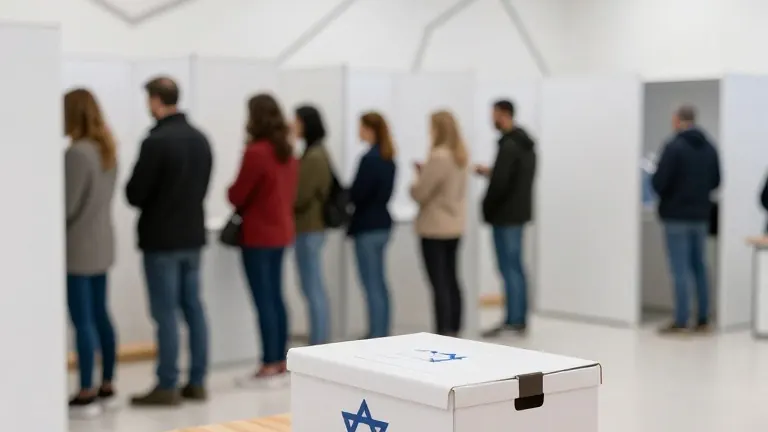
Israeli citizens went to the polls on Tuesday to vote in the first general election since the Hamas-led attack of October 7, 2023. The contest pits Prime Minister Benjamin Netanyahu against a self-styled Zionist opposition bloc, with both sides adopting a right-wing approach to national security and domestic policy.
Netanyahu, the country's longest-serving prime minister, is seeking to extend his tenure after leading a coalition of far-right ultranationalists and ultra-Orthodox parties. He faces a long-running corruption trial and wants from the International Criminal Court on charges of war crimes in Gaza. His opponents argue that the current government has failed to maintain institutional checks and balances.
The campaign focused on accountability for the security failures preceding the 2023 attack and the question of conscripting the ultra-Orthodox minority for military service. However, analysts note that the shift to the right began before Netanyahu's latest government took office in 2022. The collapse of the peace process and repeated security crises eroded the political center, leading to legislative milestones such as the 2018 Nation-State Law.
Under the current administration, the speed of the rightward drift has accelerated. The government attempted to strip the Supreme Court of its power to review government actions and flouted rulings on ultra-Orthodox conscription. Finance Minister Bezalel Smotrich and National Security Minister Itamar Ben-Gvir provided crucial support for the judicial overhaul launched in early 2023. Both ministers have also defended the surge in violence in the West Bank.
Yossi Mekelberg, a senior fellow at Chatham House, described the election as a decision on whether Israel will live in a functioning democracy or a democracy in name only. He noted that the choice also determines whether the state will maintain the occupation of the West Bank or annex it entirely. Ahron Bregman, an analyst at King's College London, said a new prime minister would likely calm the domestic atmosphere, which has become deeply divided by Netanyahu's polarizing presence.
Despite the high stakes for domestic governance, the election offers no direct mechanism for Palestinians to influence policy. More than 74,000 people have died in Gaza during the war that followed the 2023 attack. Deadly attacks continue almost daily in the territory despite a yearlong ceasefire, while settler violence and army raids have intensified in the occupied West Bank.
None of the mainstream candidates have proposed including Arab-led parties in a potential coalition. Leaders of the Ra’am party and the Joint List, which represent Palestinian citizens of Israel, are often cited by rival candidates to denounce each other. Yehouda Shenhav-Shahrabani, an Israeli sociologist, stated that the ultra-Orthodox parties would remain in government regardless of the outcome, while Arab-led parties would be excluded by a system built on prejudice.
The distinction between the parties, according to Shenhav-Shahrabani, is not between democratic and anti-democratic forces, but between Jews and Palestinians. Daniel Levy, a former Israeli government adviser, argued that the treatment of Palestinians is a consensus among Zionist parties. He noted that differences among them rest on whether the state or settler militias should lead the oppression, rather than whether the policy itself is sound.
The vote reflects a political landscape where the right-wing approach is the default. Bregman cautioned that while a change in leadership might alter the tone of governance, the overall direction of policy will mirror the sharp rightward turn that occurred after October 7. The election determines who manages the state, but not the fundamental framework of its relationship with the Palestinian population.
The results will determine whether Netanyahu remains in office or if a rival coalition takes power. Both options operate within the same ideological boundaries defined by the post-2023 political shift. The ballot does not include a referendum on the war in Gaza or the expansion of settlements, leaving those policies largely unchanged by the choice of leadership.
Source: Al Jazeera