Trump closes campaign in heartland states as Democrats fracture in Michigan
President Donald Trump held rallies in Iowa and Kansas on Sunday, while a split emerged among Democrats in Michigan over their Senate nominee.
By Natalie Castro ·
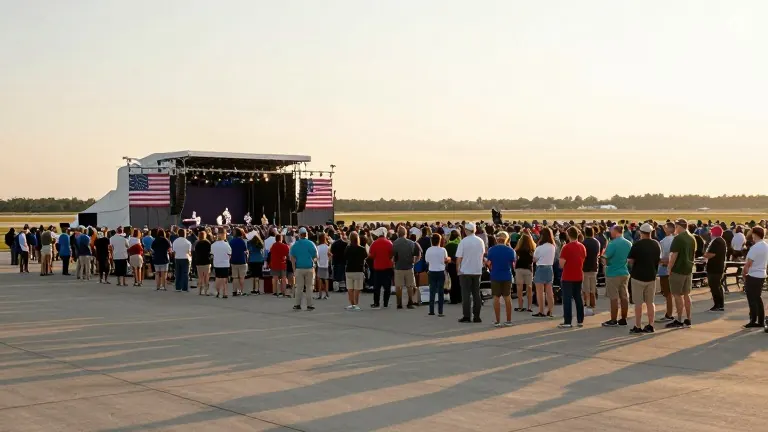
President Donald Trump concluded his campaign schedule with rallies in Iowa and Kansas on Sunday, two states where he previously secured decisive victories. These final appearances marked the end of a turbulent midterm cycle as Republicans sought to maintain their congressional majorities. The president spoke for two hours in Dubuque, Iowa, before traveling to Salina, Kansas, to address supporters at an airport rally.
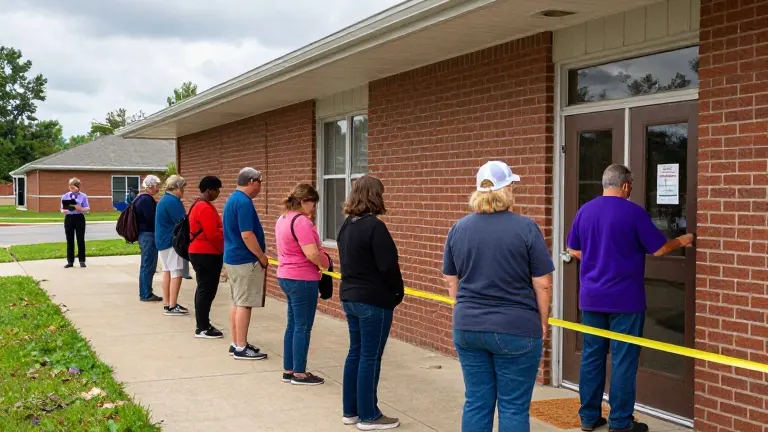
More than 54 million votes had already been cast before Election Day on Tuesday. This early turnout highlighted the defensive posture of the Republican Party as the elections serve as a referendum on Trump's second term. Unlike the 2024 cycle, where the focus was on flipping states that supported Joe Biden, this year's strategy centered on consolidating support in states where Trump had previously dominated. Voters, including past supporters, have raised questions about the economic impact of his tariff policies and the war in Iran.
In Iowa, Trump projected a sweep for Republicans. “We're going to elect ‘America first’ Republicans up and down the line,” he told the crowd. Jon Lutz, a 60-year-old civil engineer from Dubuque, attended his first rally on Sunday. Lutz said he is satisfied with the president's record and wants Republicans to retain control of Congress to advance their agenda. “He’s done what he’s said he’s going to do,” Lutz said. “I want him to keep going.”
Wendy Kuenzler, a 44-year-old from Burlington, also attended the Dubuque event for the first time. She expressed confidence that Iowa was at a crossroads and planned to support Ashley Hinson, the Republican Senate nominee. Kuenzler stated that she does not blame rising gas and grocery prices on Trump, noting that “he's on the path to correcting it.”
In Kansas, Liz Wagner, a 59-year-old restaurant owner from Atchison, traveled 165 miles to attend the rally in Salina. She said she agrees with everything Trump says and urged voters to work rather than rely on government handouts. “I want people to get up and go to work and stop sticking their hands out,” Wagner said. “The Democrats like to hand things out.”
The campaign faced complications in Michigan, where Democratic Senate nominee Abdul El-Sayed faced a challenge from his primary opponent, Haley Stevens. Stevens, a congresswoman, endorsed Republican candidate Mike Rogers after an invitation to a Democratic event was rescinded. Stevens said in a video that El-Sayed told her she was no longer welcome in his campaign. “And he’s right. And that’s why I am endorsing Mike Rogers for the United States Senate today,” Stevens said.
Michigan is a key battleground for the Democratic effort to retake the Senate. If Democrats lose that seat, they will face greater pressure to win races in Republican-leaning states such as Texas, Ohio, or Iowa. Senate Majority Leader Chuck Schumer said the party remained united in its support for El-Sayed. Kirsten Gillibrand, who leads the Democratic Senatorial Campaign Committee, added that the party would stand firmly behind El-Sayed and reject efforts to divide Democrats. Bernie Sanders, a prominent supporter of El-Sayed, dismissed concerns about a split, noting that Stevens lost a close primary but that people across the state were standing with El-Sayed.
Outgoing Rep. Don Bacon, a Republican from Nebraska, warned that tariffs could weigh down the GOP in the Midwest. “Tariffs are not popular here in the Midwest,” Bacon told CNN. He predicted a party debate if losses were significant. Sen. Tim Scott of South Carolina, chair of the National Republican Senatorial Committee, expressed confidence that Republicans would keep the Senate. “His agenda, without any question, is on the ballot,” Scott said on NBC.
Source: Philadelphia Daily News