New gas data suggests Mars still has active volcanic vents
A European space agency orbiter detected seasonal hydrogen chloride emissions near a major volcano, hinting at subsurface water and heat.
By Ayanda Kaminski ·
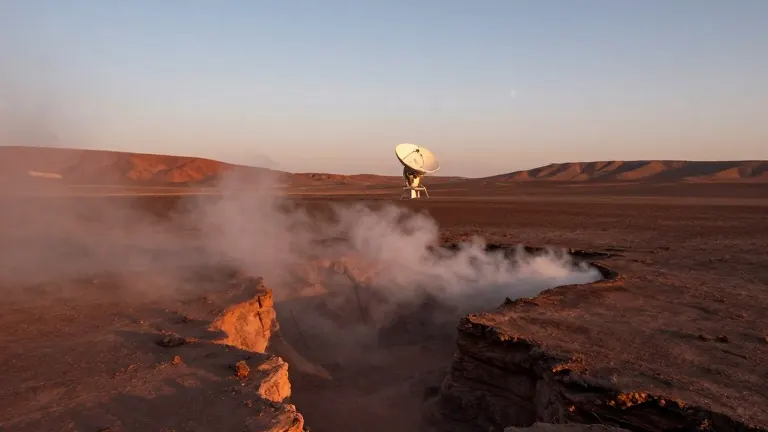
Hydrogen chloride is leaking from the surface of Mars, according to data released today in the journal Science Advances. The gas appears in seasonal bursts near the volcanic fissures of Alba Mons. This finding suggests that molten rock is still active beneath the planet's surface, keeping parts of the red planet geologically alive.
The detection was made by the ExoMars Trace Gas Orbiter, an agency spacecraft operated by the European Space Agency. The orbiter used a camera instrument named CasSSIS to image the area. Researchers identified fresh, narrow cracks in the ground, some hundreds of metres long. The team linked the presence of the gas directly to these specific volcanic structures.
The gas levels fluctuate with the Martian seasons. Hydrogen chloride peaks during the Northern Hemisphere's winter, a period lasting 154 sols. The concentration drops sharply during the summer months. Professor Daniel Mège, a Mars researcher at Poland's Academy of Sciences and a co-author of the study, explained that the seasonal nature of the release points to a specific source. The team ruled out simple dust and water cycles as the primary cause for the gas near the volcano.
Hydrogen chloride is a corrosive gas that irritates human skin. On Earth, this gas is released by magmatic vents. Its presence in the Martian atmosphere was first detected in 2021. The current data indicates that the gas is not just lingering from the past but is being actively replenished. This implies that hydrothermal systems, where hot fluids circulate underground, may still be functioning.
These underground systems create chemical environments that support life on Earth. Professor Mège noted that hydrothermal systems are primary locations where life emerged on our planet. He suggested that similar conditions on Mars could have allowed for microbial life. The hot fluids driven by magmatic gas produce reactions that generate the chemical ingredients necessary for biology.
The potential for life depends on time. The chemistry required to create life from existing materials takes a long time. Professor Mège estimated that this process could require hundreds of thousands of years or tens of millions of years. The crust of Mars, which is split into two or three layers, must have remained stable long enough for these reactions to occur. The current volcanic activity suggests that some regions may have maintained these conditions more recently than scientists previously believed.
Colin Wilson, a planetary scientist at the ESA, added that the magma could melt subsurface ice. This process would create habitable niches for potential organisms. He stated that if gas emissions are continuing to the present day, Mars may have been habitable more recently than previously thought. The team emphasized that these findings need to be verified with further observations. The data does not guarantee the existence of life, but it identifies specific areas where life could exist.
Finding evidence would require physical sampling of the surface. Professor Mège stated that researchers would probably need to dig to find biological signatures. He estimated that excavation might be necessary to a depth of 20 centimetres or up to 100 metres. The next steps involve monitoring the seasonal gas emissions and planning potential future missions to the Alba Mons region.
Source: Metro