Greece Halts Cruise Ship After Bomb Threat
Security teams searched the Crown Iris in Syros on Tuesday after an unknown caller claimed an explosive was attached to the vessel's hull.
By Natalie Castro ·
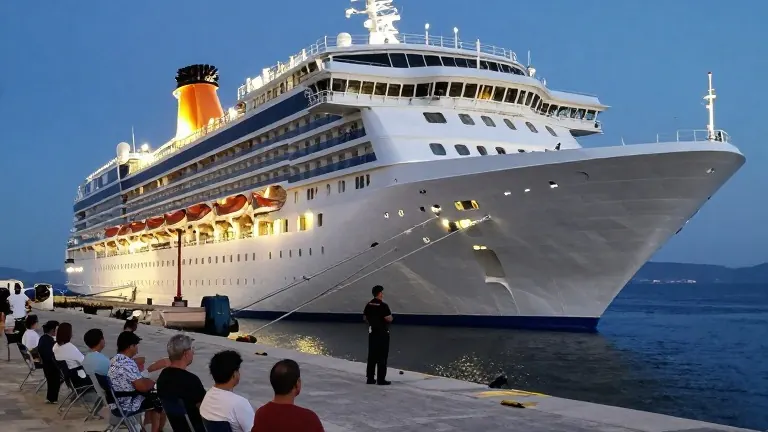
A cruise ship bound for Israel was halted at a Greek island port on Tuesday after an anonymous caller reported a bomb on its hull. The incident forced thousands of people to wait ashore while authorities conducted a search. No explosive device was found during the initial checks.
The vessel, named Crown Iris, operates under the flag of Panama and is owned by the Israeli firm Mano Maritime. It was scheduled to depart for Haifa with 940 passengers and 597 crew members on board. Greek authorities received the threat while the ship was docked at the port of Syros. Coast guard personnel, supported by a private diver and an explosives detection dog, began inspecting the ship immediately. A special coast guard unit was also deployed to the location.
Israeli military leaders joined the coordination efforts. Vice Adm. Eyal Harel, the chief of the Israeli Navy, spoke with officials from the Shin Bet and Mossad. A military source stated that the incident is being managed in conjunction with Greek security partners. Initial inspections of the hull did not reveal any explosive devices. Coast guard specialists were scheduled to arrive at 9:30 p.m. local time, or 7:30 p.m. GMT, to perform further inspections before the ship could resume its voyage.
Passengers disembarked temporarily and waited in the area for the all-clear signal. One passenger told the Israel Hayom news outlet that the crew distributed water and chairs to the waiting travelers. Elderly passengers and children took shelter in the lobby of a nearby hotel to stay warm. The passenger noted that the group remained calm, suggesting the threat was likely a prank by someone bored. “It seems like someone was bored and decided to scare the port authorities rather than finding something better to do,” the passenger said.
The event occurred on the same day that at least seven flights in Europe were targeted by similar bomb threat hoaxes. These disruptions affected several airports, though no explosives were found on those planes either. No government has formally blamed a specific country for the series of threats.
European officials have recently attributed such disruptions to hybrid attacks and sabotage by Russia and Iran. Both Moscow and Tehran have denied leading such a campaign. The timing coincides with a recent wave of cyberattacks that shut down refrigerators and freezers in supermarkets across several European nations. Eric Schouten, head of the aviation security group Dyami, described the pattern of low-cost disruptions. “From railways to the food infrastructure that you see happening with the fridges being hacked and all kinds of other operations, it does fit the narrative of Russian state actors who want to disturb Europe,” Schouten said.
Source: The Times of Israel